What Does a Car Really Cost You Per Month in Switzerland?
 Kamilya
What Does a Car Cost Per Month in Switzerland?
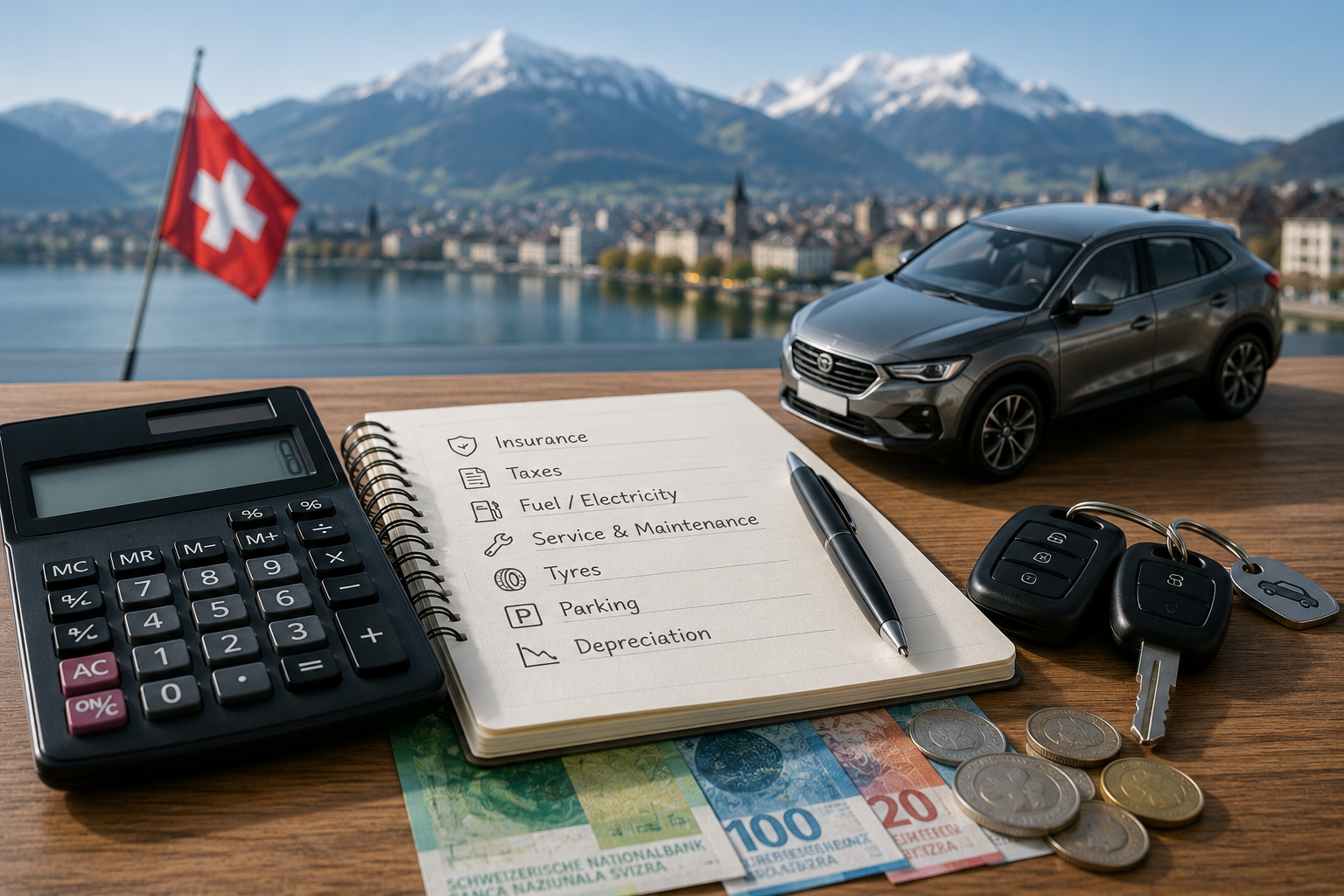
A car realistically costs you around CHF 500 to 1,100 per month in Switzerland, averaging about CHF 830, roughly CHF 10,000 per year. The largest share of that isn’t fuel but depreciation and ongoing fixed costs. The TCS calculates approximately 74 centimes per kilometre for a typical reference car, and that figure includes far more than what you pay at the fuel pump.
How high your personal bill turns out depends on three things: the vehicle itself, your annual mileage, and whether you drive a new car or a used car. An economical small car with low mileage sits at the lower end of the range; a large new car with high mileage is well above it. The important thing is to work with the full picture from the start, not just the purchase price or the monthly rate. The following sections show you item by item what this sum is made up of, where the biggest cost drivers sit, and how to keep your monthly outlay realistic and predictable.
Why Most People Underestimate Their Car Costs
Studies show that actual expenses often run up to 50 per cent above people’s own estimates. The reason almost always sits in the same two places. Depreciation doesn’t appear on any monthly bill yet hits hardest over the years. And the variable items such as servicing or a major repair come irregularly, which is why they tend to slip under the radar.
Anyone who thinks only of petrol and insurance calculates their car as cheaper than it really is. There’s also a psychological effect: one-off payments like the purchase price or the annual tax fade quickly, while the monthly fuel receipt stays front of mind. Only when you add up all the items over a full year and divide by twelve do you see the true monthly burden. That’s exactly the figure you need to plan your budget honestly.
A simple test helps: take the purchase price, estimate the resale value in three years, and divide the difference by 36 months. That amount alone surprises most people because it often exceeds total fuel costs. Knowing it means you can decide between buying, leasing, and a subscription on an honest basis.
Fixed Costs at a Glance
Fixed costs accrue whether you drive every day or the car sits in front of the house for a week. They make up the largest and most predictable part of your car costs because you know the amounts in advance and they barely change over the year.
The biggest chunk is depreciation. A new car loses roughly 10 per cent of its value per year, in the first three years often more than half of the purchase price combined. You don’t feel this loss until you sell, but you bear it every month nonetheless. Then comes insurance at about CHF 80 to 150 per month, depending on cover, vehicle, and no-claims discount. The cantonal motor vehicle tax varies noticeably by canton of residence and vehicle and can easily amount to several hundred francs per year. The motorway vignette costs CHF 40 per year, and anyone without their own parking space often pays another three-figure sum per month for a parking spot or resident parking permit. You know all these items in advance, so you should include them firmly in your calculations.
With motor vehicle tax, it’s worth checking your own canton because the differences are large. Some cantons calculate by engine displacement, others by weight or power, and some offer discounts for low-emission vehicles. For the same car, the tax can differ by several hundred francs per year depending on where you live. If you want to reduce fixed costs, you have three levers: choose a cheaper or more value-stable vehicle, match insurance cover to your actual needs, and factor in cantonal differences when choosing where to live.
Variable Costs at a Glance
Variable costs depend directly on how much and how you drive. They fluctuate from month to month and are harder to predict than fixed costs, but over the year they also add up to a considerable sum you shouldn’t underestimate.
Fuel or charging costs depend on your mileage and the vehicle’s consumption. Those who drive electrically and charge at home usually come out cheaper than with a petrol car. Servicing and repairs run roughly CHF 600 to 1,000 per 10,000 kilometres, trending towards the upper end as the vehicle ages. Anyone who drives a lot or owns an older car needs to budget significantly more here than someone with a young vehicle and low mileage. This dependence on your own driving behaviour is why two people with the same car can have completely different monthly costs.
Some of these costs can be influenced. Driving with foresight noticeably reduces fuel consumption, and keeping up with regular servicing prevents expensive consequential damage. Yet a residual element remains beyond your control: an unexpected defect or a stone chip in the windscreen arrives without warning and can throw off the monthly budget. This unpredictability is the price of ownership that many forget during their initial calculations.
Sample Calculation: How Much a Reference Car Costs Per Month
A concrete example makes the figures tangible. The basis is a reference car with a new price of CHF 45,000 and annual mileage of 15,000 kilometres, calculated using TCS values for the year 2026. The table separates plannable fixed costs from mileage-dependent variable costs.
| Cost block | Per year | Per month |
|---|---|---|
| Fixed costs (incl. depreciation, insurance, tax) | Approx. CHF 7,800 | Approx. CHF 650 |
| Variable costs (fuel, servicing, servicing) | Approx. CHF 3,300 | Approx. CHF 276 |
| Total costs | Approx. CHF 11,112 | Approx. CHF 926 |
Source: TCS kilometre costs, as at 2026. This equates to approximately 74 centimes per kilometre.
What stands out is the ratio: fixed costs at roughly CHF 650 per month make up by far the larger share, even though they’re barely noticeable in daily life. That’s exactly why so many drivers’ estimates fall too low. With a used car and a lower purchase value, depreciation in particular drops, making a used car realistically possible from around CHF 500 per month.
The calculation also becomes interesting when you vary the mileage. If you drive 8,000 instead of 15,000 kilometres per year, variable costs fall, but fixed costs stay the same. Per kilometre driven, your car becomes more expensive, not cheaper. For low-mileage drivers, this means: owning a car often makes less financial sense than it feels, because the large fixed costs are spread across fewer kilometres.
What Does a Car Cost by Category?
The vehicle class shifts the monthly bill considerably. Depreciation, fuel consumption, and insurance premiums all rise with size and purchase price. A small car stays clearly below the average; a large SUV sits well above it. The following overview gives you a rough guide to total costs per month, each calculated across all fixed and variable items.
| Vehicle class | Monthly range | Cost per kilometre |
|---|---|---|
| Small car | Approx. CHF 500–650 | Low |
| Mid-range | Approx. CHF 750–950 | Medium |
| Electric car | Approx. CHF 700–900 | Low energy costs |
| SUV / large class | From approx. CHF 1,000 | High |
Guide values based on TCS kilometre costs. Exact figures depend on model and mileage.
With an electric car, it’s worth taking a closer look. Energy costs are lower than for a combustion engine, especially if you charge at home at the household rate. On the other hand, the purchase price, and therefore the depreciation, is often higher. All in all, a mid-range EV therefore frequently lands at a similar level to a comparable petrol car, but distributes the costs differently.
This shift is the reason why looking at consumption alone rarely pays off. An inexpensive small car with high mileage can end up costing more than an economical mid-range model that holds its value better. What’s always decisive is the total of depreciation, fixed costs, and variable costs over the planned ownership period. Anyone who calculates these three blocks cleanly for their desired car makes a far better decision than someone who only looks at the list price in the showroom window.
Buying, Leasing, or Car Subscription: How to Make Costs Predictable
The many individual items can be greatly simplified depending on which model you choose. With buying and leasing, you organise and pay insurance, servicing, tax individually, and depreciation runs in the background without ever appearing on a bill. This gives you full control but also requires you to keep every item in sight yourself.
With the car subscription from CARIFY, all of that is bundled into a single monthly rate. Included are insurance, servicing, motor vehicle tax, and cantonal registration. Only fuel or charging costs are extra. For you, this means full cost transparency from the first month and no residual-value risk, because the vehicle doesn’t belong to you. The opportunity costs of tied-up capital also disappear, since you’re not committing a large sum to a purchase but keeping your money liquid. Exactly what’s included in the price is shown on the How your car subscription works page. Whether it pays off for you depends above all on how long you need the car and how important predictability is to you compared to the lowest base price.
For many, what ultimately counts isn’t just the absolute amount but the certainty that no large bill will arrive unexpectedly. When insurance and servicing are part of a fixed rate, you know in January what the car will cost you in November. This predictability is worth real money as soon as an unexpected workshop visit would otherwise blow the entire monthly budget.
How Much Does a Car Cost Per Month?
In Switzerland, you need to budget around CHF 500 to 1,100 per month, averaging roughly CHF 830. The biggest drivers are depreciation, insurance, and your mileage. A small car with low mileage stays at the lower end; a large SUV is well above it.
How Much Does It Cost to Drive 100 km in Switzerland?
According to the TCS, driving costs around 74 to 76 centimes per kilometre in 2026. For 100 kilometres, that’s approximately CHF 75. This figure includes all fixed and variable costs on a pro-rata basis, not just the fuel you see at the pump.
How Much Money Should You Spend on a Car Per Month?
As a rule of thumb, around 15 to 25 per cent of monthly income should go towards total mobility, including maintenance, insurance, and fuel. Anyone regularly exceeding this should reconsider the vehicle class or cost model before the car becomes a permanent financial burden. A cheaper vehicle or an all-inclusive solution often brings the ratio back into a healthy range quickly.
Conclusion
The purchase price is only half the story. Anyone who factors in all fixed and variable costs plans realistically and faces no surprises at the end of the month. Depreciation and running costs make up the largest share, even though they barely register in daily life. With an all-inclusive model like the car subscription, you combine the many individual items into a single transparent rate and see from the start what your car really costs.