Financing or Leasing a Car: How to Make the Right Choice
 Kamilya

You’re facing an important question: should you finance your next car or lease it? It’s one many drivers in Switzerland wrestle with, since both options have clear pros and cons. Financing makes you the owner, while leasing gives you flexibility and often lower monthly costs.
The right choice depends on your budget, driving habits, and future plans. Some people like the feeling of owning their car; others prefer the predictability and lower effort that leasing provides. And today, there’s a third option - the car subscription - offering even more flexibility for modern lifestyles.
What You’ll Learn
The key differences between car financing and leasing
The tax aspects to consider in Switzerland
When each option fits different lifestyles
How car subscriptions work as a modern alternative
Practical criteria to help you decide what suits your situation
What Does Car Financing Mean and How Does It Work?
When you finance a car, you buy it in instalments until it’s completely yours. You can choose between a bank loan, where you receive the money and pay the dealer yourself, or dealer financing, where the loan runs directly through the dealership. Both lead to ownership but differ in terms and process.
The big advantage: once the payments are complete, the car is yours. You can drive as much as you want, modify it, or sell it whenever you choose. But ownership also means taking on the full risk.
You’ll pay interest on the loan, which increases the total cost, and the car’s depreciation hits you directly - especially in the first few years. Down payments can be substantial, and once the warranty expires, repair costs are on you. It’s a good option for long-term users but not always the cheapest at the start.
What Is Leasing and How Does It Work in Switzerland?
Leasing lets you drive a car without owning it. You pay a fixed monthly fee to use the vehicle for a set period, usually two to four years. When the contract ends, you return the car or sometimes have the option to buy it.
In Switzerland, leasing follows clear rules. You agree on an annual mileage limit - typically between 10,000 and 25,000 kilometres - and the amount affects your monthly rate. When you return the car, it’s inspected for wear and tear, and any excess damage or mileage is charged.
The advantages: you often drive a newer model with modern features, the costs are predictable, and maintenance is frequently included. You don’t have to worry about resale or value loss.
The downsides: the car never belongs to you. Extra kilometres can be expensive (10-30 centimes each), and early termination usually involves hefty penalties. If you like spontaneous road trips or flexibility, leasing can feel restrictive.

Financing vs Leasing - The Main Differences
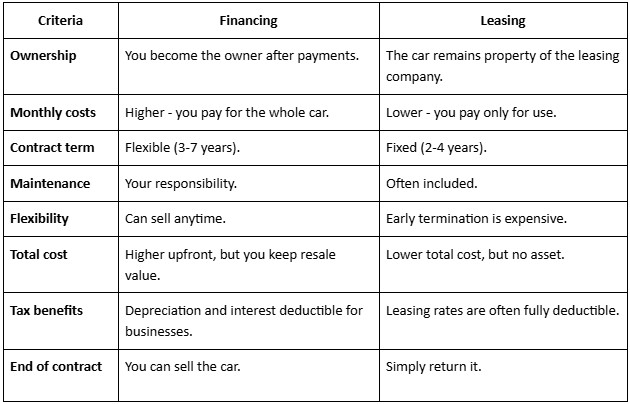
In simple terms, financing is about ownership, while leasing is about usage. Leasing payments are usually lower since you’re only covering depreciation, not the full price. Financing costs more each month but leaves you with an asset at the end - which can be worthwhile if you plan to keep the car for years.
Tax and Legal Aspects in Switzerland
Taxes can play a major role if you use your car for business. With financing, you can deduct interest and depreciation, and the car counts as an asset in your balance sheet. With leasing, monthly payments can often be written off as business expenses, which may be more attractive at higher tax rates.
For private individuals, neither option usually brings tax benefits, so the decision comes down to lifestyle and financial priorities.
Legally, a financed car is your property - with all rights and responsibilities. In leasing, you’re a user, not an owner, so you must follow specific conditions like approved servicing and mileage limits.
Car Subscription - The Flexible Alternative
A car subscription combines the best of both worlds. You pay one monthly price that often covers everything - insurance, tax, maintenance, and sometimes even fuel or charging.
The focus is flexibility. You’re not tied to one car for years; you can switch models or cancel after a few months. This makes subscriptions ideal for people whose needs change frequently - urban drivers, young professionals, or anyone who values convenience over ownership.
CARIFY, Switzerland’s leading car subscription platform, partners with over 300 garages and offers transparent, all-inclusive pricing. No lengthy contracts, no resale hassle, no unexpected costs - just full cost control.
For those who prioritise flexibility and simplicity, subscriptions provide a smart, modern answer to traditional ownership models.

How to Make the Right Choice
Your personal situation determines what’s best. Ask yourself: Is owning a car important to you? How many kilometres do you drive each year? Do you plan to keep the car for more than five years? How much flexibility do you need?
Financing suits long-distance drivers and families who want to keep their vehicle long-term. Leasing fits those who prefer new models and predictable costs. Car subscriptions are perfect for people who need maximum flexibility or don’t want long-term commitments.
There’s no universally right choice - only the right one for your lifestyle.
Key Takeaways
Financing suits long-term users who value ownership. Leasing offers predictability and access to newer models but with limits. Car subscriptions combine flexibility with convenience - often at a higher price. Tax benefits may influence business users. Your driving habits and plans ultimately determine the best fit.
The Right Option for Your Driving Style
Choosing between financing, leasing, or a car subscription isn’t about right or wrong - it’s about what fits your needs. Financing offers independence and ownership; leasing balances cost and convenience; subscriptions offer ultimate flexibility in a fast-changing world.
As mobility evolves and new technologies like electric cars reshape the market, the best choice today might not be the same tomorrow. Reassess your situation regularly - flexibility is becoming the most valuable feature of all.
If you’re curious about flexible car subscriptions, check out CARIFY - Switzerland’s leading platform for effortless, modern mobility.
FAQ
Which is cheaper - financing or leasing?
Financing is often cheaper if you keep the car long-term since you retain its value. Leasing can be cost-effective for shorter terms or if you prefer driving newer models. Subscriptions are the most flexible but usually cost more.
Which option is more flexible?
Car subscriptions offer the highest flexibility, with short terms and model changes. Financing gives you freedom to sell anytime, while leasing ties you to fixed terms.
What extra costs should I expect?
With financing: interest, maintenance, insurance, and depreciation. With leasing: possible fees for excess mileage or damage. With subscriptions: almost everything is included, but check for hidden fees.
How does a car subscription differ from leasing?
Subscriptions are shorter-term and all-inclusive, covering costs like insurance and maintenance. Leasing locks you in longer and usually excludes extras but may cost less per month.