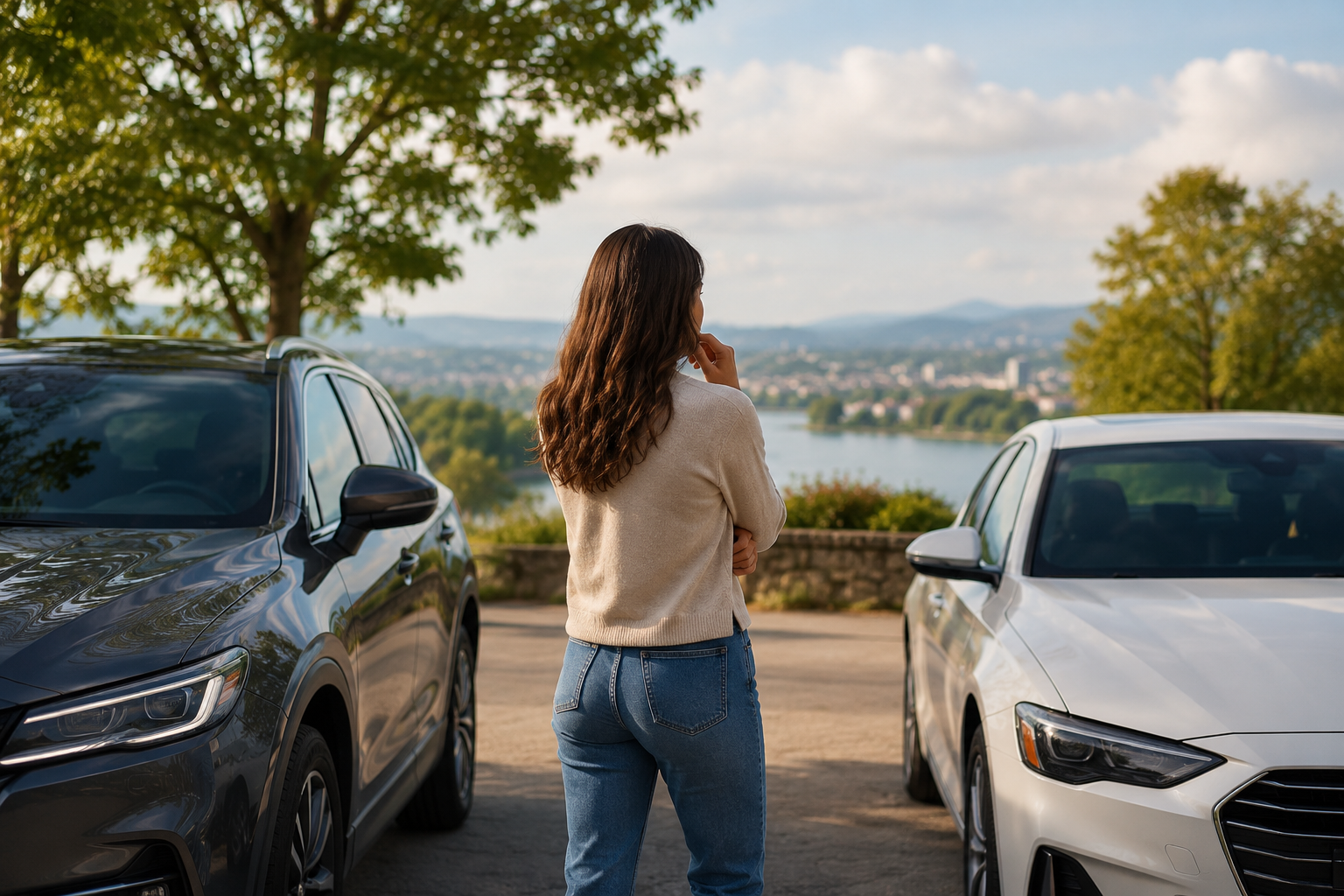
Is a Second Car Worth It? Why a Car Subscription Is the Smarter Alternative
 Kamilya
A second car in Switzerland costs between CHF 600 and 900 per month in fixed running costs, before you add a single franc of fuel. That figure includes depreciation, insurance, cantonal motor vehicle tax and service costs.
Most households that buy a second car underestimate this figure significantly. They calculate the monthly loan repayment or the purchase price spread over years, and they forget that depreciation, insurance and tax run whether the car moves or not.
What Does a Second Car Actually Cost Per Month in Switzerland?
The total monthly cost of a second car is made up of several components that rarely appear on the same bill. Understanding all of them together is the only honest way to compare owning a second vehicle against the alternatives.
Purchase price and depreciation in CHF
A new mid-range car costs between CHF 35,000 and 45,000 in Switzerland. In the first three years, it loses roughly 40 to 50% of its value, which translates to a monthly depreciation of CHF 490 to 625. If you buy a used car for CHF 18,000 to save money upfront, the percentage loss is lower, but you still lose CHF 165 to 220 per month in value over the following three years.
Depreciation is the largest single cost of car ownership. It never appears on a bill, which is why it's so easy to ignore.
Insurance, motor vehicle tax and service costs in Switzerland
A second car insurance policy in Switzerland costs CHF 80 to 150 per month depending on your canton, the model and your driving history. The motor vehicle tax (Motorfahrzeugsteuer) varies widely by canton and engine size, but typically lands between CHF 40 and 120 per month. Routine service, inspection and minor repairs add another CHF 80 to 200 per month, less if the car is under warranty, more as it ages.
Add those three lines together with depreciation and you're looking at CHF 600 to 900 per month in fixed costs, before fuel.
The 'hidden' costs most people forget
Parking. In Zurich, Geneva or Basel, a monthly parking permit runs CHF 100 to 300. Even in smaller towns, a garage or reserved parking space adds CHF 80 to 150. Registration paperwork for a new vehicle costs time and cantonal fees. And if anything goes wrong outside the warranty period, a single repair can absorb months of what you thought you were saving by not paying for a subscription.
The Swiss motorway vignette (CHF 40 per year) is a minor item, but it's one more fixed cost that doesn't exist with a car subscription, where it's included in the monthly rate.
When Does a Second Car Actually Make Sense?
The calculation shifts significantly depending on how much you actually drive the second car and for how long you plan to keep it.
Households where two cars are genuinely necessary
Two people working in different directions, with schedules that make public transport genuinely impractical, are the obvious case. If one person commutes to an industrial zone not served by rail, or works rotating shifts that start before the first train, a second car isn't a luxury. The same applies to households in rural cantons where the nearest SBB station is 20 minutes away and Postauto runs three times a day.
Families regularly transporting heavy equipment, musical instruments, sports gear or a large dog can make a case for two cars if their primary vehicle is already maxed out. If your SUV is always full of football kits and your partner can't get to work without leaving you stranded, the economics of a second car actually hold up.
When the maths works against a second car
If you need the second car fewer than 60 to 80 days per year, you're paying CHF 7,200 to 10,800 in annual fixed costs for a vehicle that sits idle most of the time. Renting a car for those 60 to 80 days at CHF 80 to 100 per day would cost CHF 4,800 to 8,000, with no depreciation, no insurance policy and no tax bill.
The other losing scenario is buying a second car when your actual need is temporary. Starting a new job and unsure whether you'll need to drive for the next 18 months? A car subscription covers that period and ends when your situation becomes clear, without a vehicle to sell.
Car Subscription as a Second Car: How Does It Compare?
A Swiss car subscription gives you a vehicle for a fixed monthly price that covers insurance, taxes, service and registration. You handle the fuel. That's the full extent of your obligation.
Monthly cost comparison: owned second car vs. subscription
An entry-level car subscription in Switzerland starts at around CHF 500 per month. A compact car subscription with a sensible mileage package runs CHF 550 to 700 per month. Against the CHF 600 to 900 per month total cost of owning a second car (before fuel), the subscription sits in the same range or below it, particularly when you account for the upfront capital you're not spending.
The owned second car becomes cheaper per month only after you've held it long enough for depreciation to slow down significantly, typically after five to seven years with high mileage. Before that point, the subscription often wins on total cost.
What's included in a Swiss car subscription
A CARIFY subscription includes insurance, motor vehicle tax, service and registration in the monthly flat rate. There's no separate insurance policy to arrange, no cantonal tax bill to budget for, and no service appointment to organise on your own time and budget. You receive one monthly invoice.
For households using a subscription as a second car, this simplicity is part of the value. You're not managing a second vehicle administratively, you're just paying one bill.
Flexibility: cancel, switch models, adjust mileage
CARIFY subscriptions run with monthly cancellation after the minimum term. If your circumstances change, a new job, a move, a family change, you end the subscription and walk away. Compare that to selling a second car, which involves pricing research, listing platforms, test drives with strangers and a negotiation process that can take months.
You can also adjust your mileage package monthly to match your actual usage, and switch to a different vehicle type when your needs change. That kind of flexibility has no equivalent in traditional car ownership.
Who Benefits Most From a Subscription Instead of a Second Car?
Not everyone benefits equally. The subscription model works best for people whose second-car need has some variability or uncertainty attached to it.
Commuters with variable schedules
If you sometimes need a car for your commute and sometimes don't, a subscription beats ownership on flexibility. You're not paying CHF 800 per month to park a car you drove four times last month. With a subscription, you at least get consistent value from the vehicle, and you can cancel when the need disappears.
Families with seasonal or occasional extra-car needs
The ski season runs from December to March. If your main reason for wanting a second car is a four-wheel-drive for mountain trips, a three or four-month subscription with the right model covers that period without committing to a year-round cost. Similarly, families whose children are old enough to drive and occasionally need a second car can subscribe for a year rather than buy.
The Environmental and Space Case Against a Second Car
A car that sits in a parking space for 80% of its life still consumed roughly 15 tonnes of CO2-equivalent to manufacture. Running two cars in a household when one is underused doubles the production impact per kilometre driven. From a purely practical angle, a second car also occupies space. In Swiss cities and suburbs where parking is scarce and expensive, freeing up one vehicle's parking space reduces a real monthly cost and a daily logistics problem.
A subscription used only when needed concentrates the carbon and cost of a vehicle into the periods it's genuinely useful. For households that care about this, the subscription model allows lower overall vehicle impact without sacrificing mobility.
Is It a Good Idea to Get a Second Car?
It depends on how much you'll use it and for how long. If both people in a household need reliable independent mobility every working day, and you plan to keep the car for five or more years, buying a second car often makes financial sense in the long run. If the need is occasional, seasonal or uncertain in duration, the CHF 600 to 900 monthly fixed cost of a second car is harder to justify against a subscription that costs similar money but carries no long-term commitment.
Is It Better to Have One or Two Cars?
One car works well for most Swiss households with good public transport access, especially in cities where trams, buses and the SBB cover most routes efficiently. Two cars make sense when two people have genuinely incompatible mobility needs that can't be solved by scheduling, carsharing or public transport. The decision isn't about preference, it's about whether the actual usage justifies the cost. Run the numbers honestly for your own situation before committing.