Best Hybrid SUVs in Switzerland: Models, Fuel Economy and Prices Compared
 Kamilya
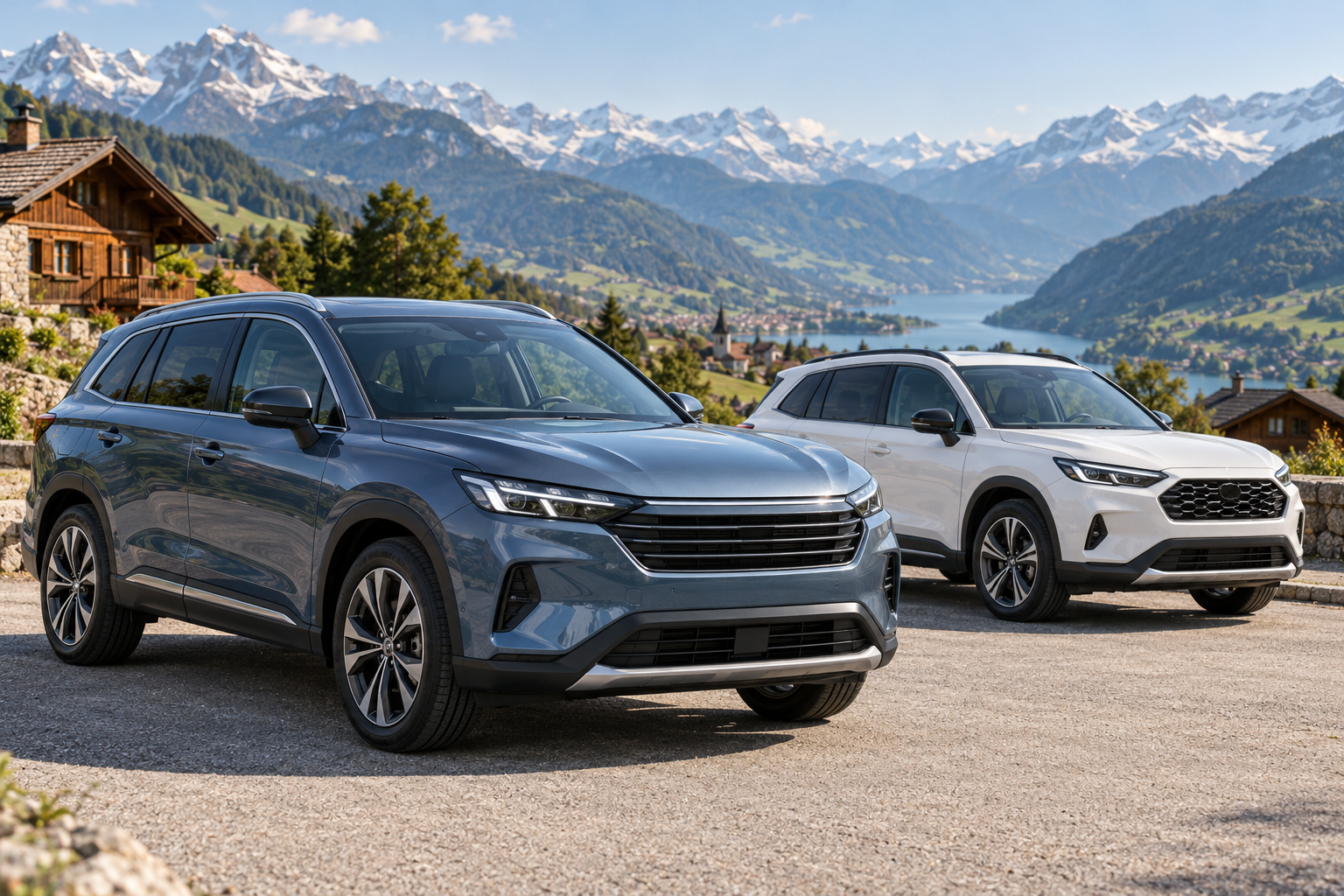
Hybrid SUVs account for a growing share of new car sales across Switzerland and Europe. The concept is straightforward: a combustion engine paired with one or more electric motors saves fuel without the range limitations of a full EV. But the marketing figures rarely match the reality. A PHEV with a claimed 1.5 litres per 100 km can burn through eight litres if you never charge the battery. Knowing the difference matters before you sign.
This guide explains the three hybrid technologies, compares the best models available in Switzerland with real-world fuel consumption figures and CHF prices, and gives you clear recommendations based on how you drive.
What Is a Hybrid SUV?
A hybrid SUV combines a petrol or diesel engine with one or more electric motors. The electric motor draws power from a battery that recharges through braking, the combustion engine, or an external plug, depending on the hybrid type. Unlike a full EV, the hybrid keeps a combustion engine as backup. For buyers in Switzerland, where alpine passes and long valley-to-city commutes are routine, this means zero range anxiety and fast refuelling on any road.
Three main categories exist: full hybrid (HEV), plug-in hybrid (PHEV) and mild hybrid (MHEV). Which suits you depends on your daily driving distance and whether you have access to a charger at home or work.
Types of Hybrid SUV: Which Technology Suits Your Driving?
Full Hybrid (HEV): Self-Charging, No Plug Required
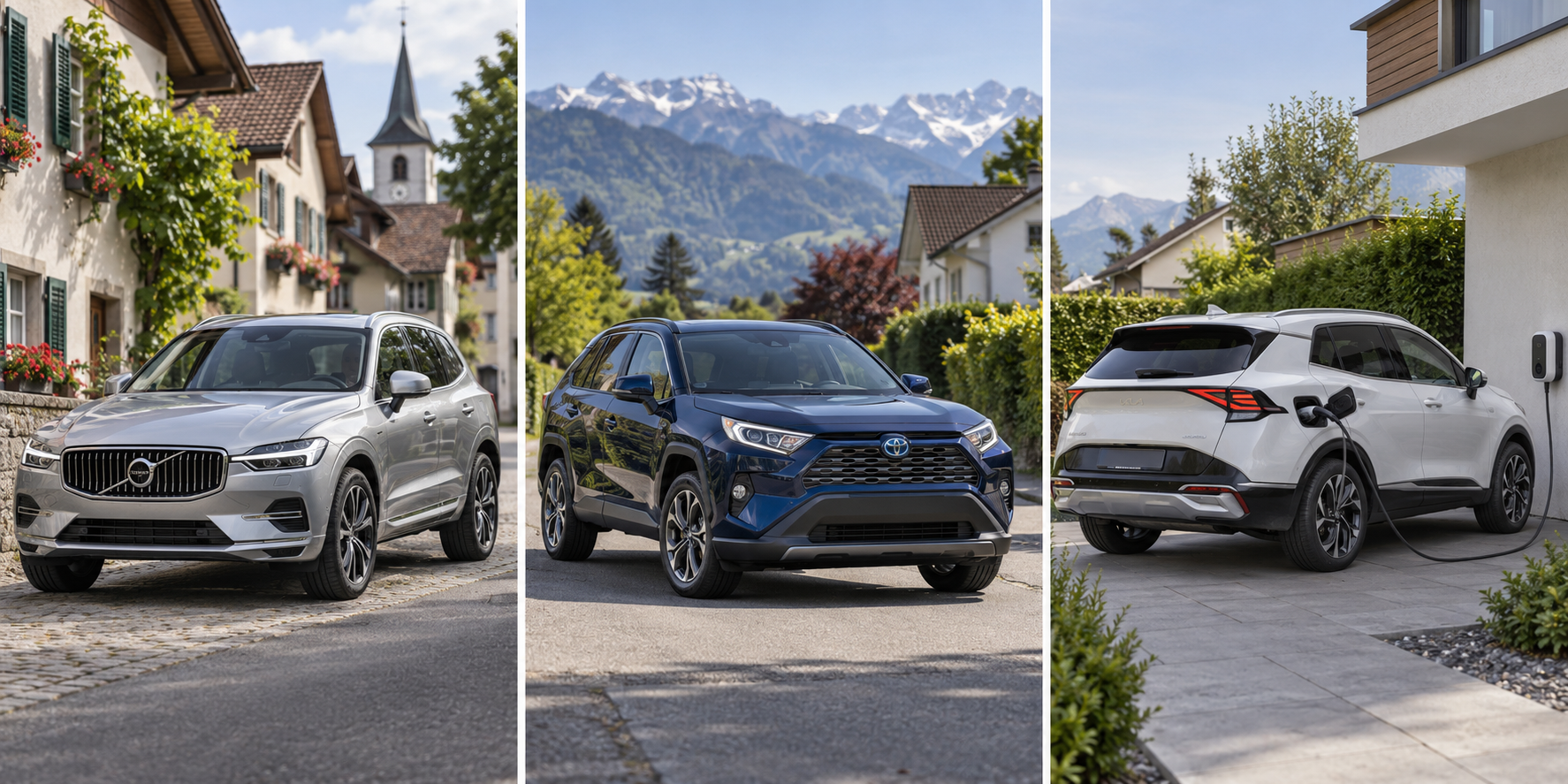
A full hybrid charges its battery through regenerative braking and the combustion engine. No cable, no socket, no change to your routine. Typical electric-only range is one to three kilometres at low speed, enough for parking garage manoeuvres or stop-and-go traffic. The Toyota RAV4 Hybrid is the reference in this category and the best-selling hybrid SUV in Europe.
Best for drivers without home charging, renters, and anyone who wants fuel savings with zero lifestyle change.
Plug-in Hybrid (PHEV): More Electric Range With a Charger
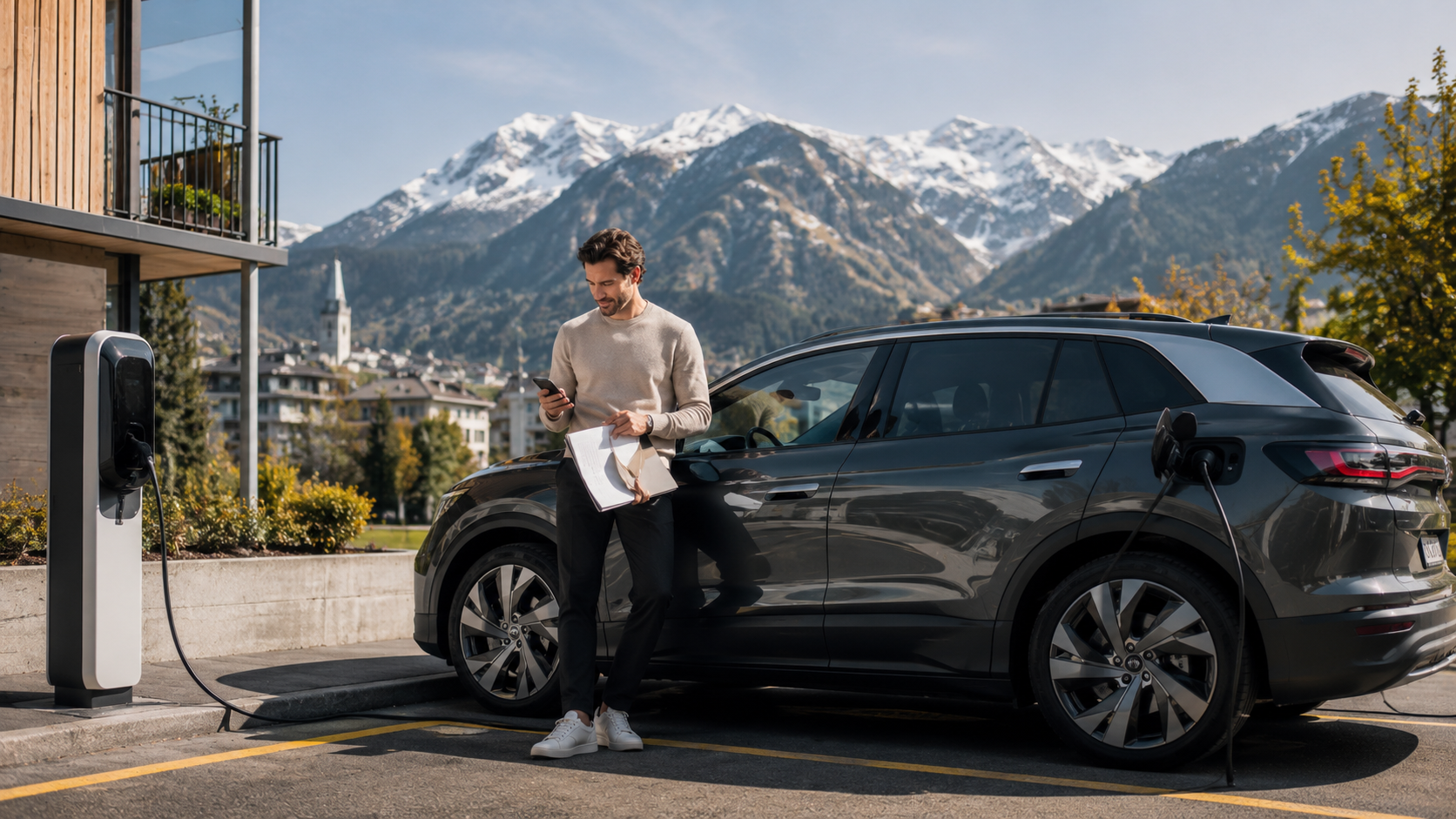
A PHEV carries a larger battery (15 to 30 kWh) that you charge at a wall socket or wallbox. Electric-only range runs 50 to 100 km on the WLTP cycle. Many Swiss commuters cover their entire daily drive on electric power alone: the trip from a Zurich suburb to the office and back fits within 50 km.
The catch: without regular charging, a PHEV can consume more fuel than a full hybrid. The heavier battery becomes dead weight if you run it on petrol alone. A PHEV only saves money when you plug it in.
Mild Hybrid (MHEV): A Small Boost, No Electric Driving
A mild hybrid adds a 48V electric motor that assists the combustion engine under acceleration and enables a smoother stop-start system. It cannot propel the car on its own. Fuel savings run three to seven percent compared to a pure combustion engine. The MHEV is the cheapest entry point into hybrid technology, suitable for buyers who want a slight efficiency gain without changing how they drive.
What to Consider When Buying a Hybrid SUV in Switzerland
Real-World Range vs. WLTP: Why the Numbers Differ
WLTP fuel consumption tests start with a fully charged battery. For PHEVs, this produces official figures of one to two litres per 100 km that almost no one replicates in daily use. A Kia Sportage PHEV driven without charging consumes around seven to eight litres per 100 km. Fully charged on a city commute: 1.5 to 2.0 litres. A Toyota RAV4 Hybrid (self-charging, no plug) averages 6.5 to 7.5 litres in the real world. Honest numbers are the only basis for a sound purchase decision.
Charging at Home and on the Road in Switzerland
Charging a PHEV from a regular Swiss household socket takes six to ten hours. A wallbox cuts that to two to four hours. Switzerland has more than 12,000 public charging points spread across networks like IONITY, Migrol, CKW and Shell Recharge. For PHEV owners, a home wallbox is the single most important factor in making the car economical. Public chargers work for occasional top-ups, but relying on them for daily charging is impractical.
All-Wheel Drive: Electric vs. Mechanical AWD
Several hybrid SUVs achieve AWD by adding an electric motor to the rear axle rather than using a mechanical driveshaft. The Toyota RAV4 Hybrid is the clearest example. Electric AWD responds faster, weighs less and reduces maintenance compared to a mechanical system. For families in alpine cantons like Graubuenden, Valais or the Bernese Oberland, AWD is a genuine safety advantage on snowy side roads and steep driveways.
Tax Benefits and Incentives in Switzerland
PHEVs are exempt from motor vehicle tax in several Swiss cantons, including Zurich, Bern and St. Gallen. There is no federal purchase subsidy. The cantonal differences are significant, so check your own canton's rules before buying. This tax advantage makes PHEV SUVs particularly attractive in Switzerland compared to other European markets.
The Best Hybrid SUVs Available in Switzerland in 2026
The following models were selected for Swiss market availability, real-world fuel efficiency, safety rating and value for money. The comparison covers full hybrids and PHEVs, ordered from volume models to premium.
Toyota RAV4 Hybrid: Europe's Best-Selling Hybrid SUV
The RAV4 Hybrid is the most proven choice. Toyota's decades of hybrid experience show in the excellent long-term reliability record and a real-world fuel consumption of around 6.5 to 7.5 litres per 100 km. Electric AWD with no mechanical driveshaft keeps maintenance costs down. From around CHF 45'000. The only limitation: no plug-in option, so you cannot charge externally.
Kia Sportage PHEV: Best Value in the Compact Segment
The Sportage PHEV delivers the strongest overall package for value-conscious buyers. Generous standard equipment, a seven-year warranty, around 70 km of electric range (WLTP) and electric AWD make it the benchmark in its class. From around CHF 49'000. Limitation: AC charging maxes out at 7.2 kW, and the boot is slightly smaller due to the battery.
Hyundai Tucson PHEV: Refined and Comfortable
The Tucson PHEV shares its drivetrain with the Sportage but offers a more upmarket interior and higher comfort levels. 70 km electric range, five stars at Euro NCAP and a generous cabin. From around CHF 53'000.
Ford Kuga PHEV: Family-Friendly With a Large Boot
The Kuga PHEV has one of the largest boots in the segment and a 14.4 kWh battery delivering around 55 km of electric range. Fair pricing from around CHF 46'000, solid safety kit and good long-distance ability thanks to a large fuel tank. Limitation: no electric AWD available.
BMW X3 xDrive30e: Premium Performance
292 PS of system power, around 50 km of electric range and BMW's trademark driving dynamics make the X3 PHEV the most powerful and most engaging model in this comparison. From around CHF 68'000. The premium is clear, but for buyers who value driving pleasure over pure efficiency, the X3 is the right call.
Volvo XC60 Recharge: Scandinavian Safety Focus
Around 65 km of electric range (WLTP). From CHF 70'000. Outstanding driver assistance systems and Volvo's safety reputation. Sustainable interior materials including recycled plastics and responsibly sourced leather. For buyers who prioritise safety and environmental credentials alongside performance.
VW Tiguan eHybrid: The Mainstream All-Rounder
The third-generation Tiguan eHybrid brings a larger battery with around 100 km of electric range (WLTP) and 11 kW AC charging. Familiar VW user experience, a wide dealer network and strong resale values. From around CHF 53'000. The safe, rational choice for families who want a PHEV without complications.
Mitsubishi Eclipse Cross PHEV: Cheapest PHEV With Real AWD
The Eclipse Cross PHEV is the bargain in the segment: from around CHF 43'000, twin-motor AWD and around 55 km of electric range. The infotainment technology is a generation behind the competition and fuel consumption runs slightly higher, but for budget-focused buyers who need AWD, it is a solid option.
Peugeot 3008 Hybrid: The Stylish French Alternative
The 3008 PHEV makes a design statement with its award-winning i-Cockpit interior. Around 60 km of electric range, front-wheel or all-wheel drive as options. From around CHF 49'000. For buyers who value visual individuality over brand familiarity.
Hybrid SUV Fuel Economy: Who Really Saves the Most?
WLTP vs. Real Consumption: Why PHEVs Often Use More Than Advertised
The WLTP test cycle runs with a full battery. Official PHEV figures of one to two litres per 100 km only hold true when you charge regularly and drive short distances. Without charging, a PHEV consumes seven to eight litres per 100 km, sometimes more than an efficient full hybrid. The rule is simple: a PHEV saves fuel only when you plug it in.
The Most Fuel-Efficient Hybrid SUVs Ranked
Among full hybrids, the Toyota RAV4 Hybrid leads at around 6.5 litres per 100 km. Among PHEVs, the Kia Sportage and VW Tiguan eHybrid achieve under two litres in charged city driving. On the motorway with an empty battery, consumption rises to seven to nine litres. Your real-world average depends on the ratio of short trips to long hauls.
Hybrid SUV Prices in Switzerland: What to Budget
Price Overview by Segment and Drivetrain
Compact PHEVs start at around CHF 43'000 (Mitsubishi Eclipse Cross) and run to CHF 53'000 (Hyundai Tucson). The only full hybrid in this comparison, the Toyota RAV4, begins at CHF 45'000. Premium PHEVs from BMW and Volvo range from CHF 68'000 to CHF 70'000.
Leasing vs. Buying: Which Makes Sense for a Hybrid SUV?
PHEVs often lease well because residual values are stable and cantonal tax exemptions reduce the total cost. Over four years, leasing can work out cheaper than buying, especially for business users. A car subscription through CARIFY offers another path: insurance, taxes and service are included in the monthly price, and you can switch or cancel monthly without a multi-year commitment.
Residual Values and the Used Market for Hybrid SUVs
Full hybrids, especially Toyota models, hold their value better than PHEVs because buyers worry less about battery degradation. When buying a used PHEV, check the battery state of health (an SoH reading from a dealer diagnostic), review the charging history and confirm the remaining manufacturer warranty on the battery pack.
Hybrid SUV or Electric SUV: Which Fits Better?
A hybrid SUV avoids range anxiety and refuels in minutes. Motorway journeys across Switzerland need no planning around charger locations. Purchase prices run lower than comparable electric SUVs.
A full electric SUV costs less to run (electricity is cheaper than petrol in Switzerland) and produces zero local emissions. The technology is simpler, and cantonal tax exemptions in several cantons sweeten the deal.
For drivers with a home charger who stick to city and suburban routes, an electric SUV is often the better financial choice. For high-mileage drivers, families without home charging, or anyone not ready to go fully electric, the hybrid remains the practical solution. Trying both via a CARIFY car subscription lets you test each technology before committing.
Frequently Asked Questions About Hybrid SUVs
Which hybrid SUV has the lowest fuel consumption?
Among full hybrids, the Toyota RAV4 Hybrid leads at around 6.5 litres per 100 km in real-world use. Among PHEVs, the Kia Sportage and VW Tiguan eHybrid drop below two litres when charged and driven in the city. Your personal charging habits determine the real saving.
Is a PHEV worth it without a home charger?
For most drivers, no. Without home charging, a PHEV burns as much fuel as or more than an efficient full hybrid because the unused battery adds weight. The exception is if you can charge reliably at your workplace. Without a charger, a full hybrid like the Toyota RAV4 is the better pick.
Which hybrid SUV is best for long motorway drives?
Full hybrids like the Toyota RAV4 or PHEVs with a large fuel tank (Ford Kuga: 52-litre tank) handle long distances best. PHEVs consume noticeably more on the motorway at higher speeds with a depleted battery. Beyond 150 km in a single stretch, an efficient full hybrid is often the more economical choice.
Are hybrid SUVs still eligible for tax breaks in Switzerland?
There is no federal purchase subsidy. The main incentive is cantonal motor vehicle tax exemption for PHEVs in several cantons including Zurich, Bern and St. Gallen. Check the current rules for your canton before buying, as the criteria and exemptions vary.